DMA food sources:
Groceries
Meats:
Durocs Quality Meats (34427 Jefferson, Harrison Township, 810-792-1820)
Italian:
Alcamo's Market (4423 Schaefer Road, Dearborn)
Mexican:
La Colmena (the Honey Bee) (2443 Bagley, Detroit, 313-237-0295)
E&L (6000 W. Vernor, Detroit, 313-554-2140)
Asian Markets:
China Merchandise, (John R and 13 Mile Road in Madison Heights)
Oriental Market & Restaurant, (John R near 12 Mile in Madison Heights)
Zhongshan Oriental Groceries (5734 N. Telegraph Dearborn Heights)
Evergreen Supply Co., (20736 Lahser Road in Southfield)
Story
African:
K&K African Food Market(19490 Livernois, Detroit)
Tropical Food Market (3020 E. Grand Blvd., Detroit)
Eating Out:
- Ribs at Bert's-
- Russian at The Fiddler (6676 Orchard Lake Rd. West Bloomfield, MI 48322)
- Traffic Jam & Snug
- Nigerian- A Taste of Africa (17338 W. Seven Mile, Detroit, 313-387-8056).
- Chocolate at Sydney Bogg (18932 Woodward in Detroit & 1205 S. Main Street in Royal Oak and 3584 W. Maple in Bloomfield Hills.)
- Strudel at The Hungarian Strudel Shop (6816 Park Ave., Allen Park, 313-383-3440)
- Iraqi- Khan Merjan (6431 Miller Rd., Dearborn, 313-581-8585)
Culinary Bookstores:
Wine and Food Library (1207 West Madison, Ann Arbor, MI 48103)
Other Resources:
MetroTimes Guide to Restaurants
MetroTimes Eater's Digest Archives
AnnArbor Food
Wednesday, November 30, 2005
In Drear-nighted December (Keats)
In drear-nighted December,
Too happy, happy tree,
Thy branches ne'er remember
Their green felicity:
The north cannot undo them
With a sleety whistle through them;
Nor frozen thawings glue them
From budding at the prime.
A gentle girl and boy!
But were there ever any
Writhed not at passed joy?
The feel of not to feel it,
When there is none to heal it
Nor numbed sense to steel it,
Was never said in rhyme.
In drear-nighted December,
Too happy, happy tree,
Thy branches ne'er remember
Their green felicity:
The north cannot undo them
With a sleety whistle through them;
Nor frozen thawings glue them
From budding at the prime.
In drear-nighted December,
Too happy, happy brook,
Thy bubblings ne'er remember
Apollo's summer look;
But with a sweet forgetting,
They stay their crystal fretting,
Never, never petting
About the frozen time.
A gentle girl and boy!
But were there ever any
Writhed not at passed joy?
The feel of not to feel it,
When there is none to heal it
Nor numbed sense to steel it,
Was never said in rhyme.
Thursday, August 25, 2005
Sunday, July 10, 2005
Laughter
Perhaps I know best why it is man alone who laughs; he alone suffers so deeply that he had to invent laughter.
- Nietzsche
Laughter or tears, both derive from God.
- Sophocles
And the self-same well from which your laughter rises was often-times filled with your tears.
-Kahlil Gibran
Laughter: An Essay on the Meaning of the Comic Henri Bergson
Perhaps I know best why it is man alone who laughs; he alone suffers so deeply that he had to invent laughter.
- Nietzsche
Laughter or tears, both derive from God.
- Sophocles
And the self-same well from which your laughter rises was often-times filled with your tears.
-Kahlil Gibran
Laughter: An Essay on the Meaning of the Comic Henri Bergson
Tuesday, March 29, 2005

Wednesday, March 23, 2005
Tuesday, March 01, 2005
2005- The Year of Russian Literature (or so Ive deemed it).
Modern Russian Literature from Chekov to the Present (Prof. Bershtein-Reed College)
Russian Literature (Columbia Electronic Encyclopedia article)
Russian Literature : 19th Century (from WaytoRussian.net)
I have decided to read a majority of Russian works in the coming year.
Works read so far:
A History of Russian Literature-From Its Beginnings to 1900- D.S. Mirsky (in progress)
Master and Margarita-Bulgakov
Dead Souls- Gogol ( I could not for the life of me finish this. It depresses me that I cannot seem to see the 'genius' in this work - I will try again before the year is through)
A Hero of Our Time- Lermontov
Oblomov- Goncharov (in progress)
Modern Russian Literature from Chekov to the Present (Prof. Bershtein-Reed College)
Russian Literature (Columbia Electronic Encyclopedia article)
Russian Literature : 19th Century (from WaytoRussian.net)
I have decided to read a majority of Russian works in the coming year.
Works read so far:
A History of Russian Literature-From Its Beginnings to 1900- D.S. Mirsky (in progress)
Master and Margarita-Bulgakov
Dead Souls- Gogol ( I could not for the life of me finish this. It depresses me that I cannot seem to see the 'genius' in this work - I will try again before the year is through)
A Hero of Our Time- Lermontov
Oblomov- Goncharov (in progress)
Monday, February 28, 2005


Thursday, February 17, 2005
Ok so I shall add bit and piece to my comments on M&M:
Lale had previously mentioned:
Last night as I was reading M&M, I was very surprised to see that the existence of Jesus was in debate.
I had come across an article on Bulgakov that discusses the historical sources on Christianity referenced in Bulgakov's notebooks for M&M. We find the usual suspects, Renan & Farrar- but also Arthur Drew's The Christ Myth- the theme of which is simple: Jesus was a mythical character who never existed - and the materials that make up the gospels are simply an amalgamation of various pre "Christian" religions. (Which still begs the distinction between Truth and fact- many lanterns but one light).
The article is rather illuminating - especially in suggesting that in order to understand Woland's character- one cannot rely solely on Christian ideas about Good and Evil, God and Satan. Instead, Bulgakov used characteristics from various pre-christian religions (relying on Drews) to compose his character.
To give a brief but illuminating example:
""Mithras was the suffering Redeemer and mediator between God and the world, while Saoshyant, on the other hand, was the judge of the world who would appear at the end of all time and obtain the victory over Ariman"-the name, significantly, of one of the Master's literary persecutors in the novel"
The article if anyone is interested:
'The Mythic Bulgakov: The Master and Margarita and Arthur Drews's The Christ Myth appeared in Slavic and Eastern European Journal, 1999, Vol. 43, No. 2 pp. 347-360
Lale had previously mentioned:
Last night as I was reading M&M, I was very surprised to see that the existence of Jesus was in debate.
I had come across an article on Bulgakov that discusses the historical sources on Christianity referenced in Bulgakov's notebooks for M&M. We find the usual suspects, Renan & Farrar- but also Arthur Drew's The Christ Myth- the theme of which is simple: Jesus was a mythical character who never existed - and the materials that make up the gospels are simply an amalgamation of various pre "Christian" religions. (Which still begs the distinction between Truth and fact- many lanterns but one light).
The article is rather illuminating - especially in suggesting that in order to understand Woland's character- one cannot rely solely on Christian ideas about Good and Evil, God and Satan. Instead, Bulgakov used characteristics from various pre-christian religions (relying on Drews) to compose his character.
To give a brief but illuminating example:
""Mithras was the suffering Redeemer and mediator between God and the world, while Saoshyant, on the other hand, was the judge of the world who would appear at the end of all time and obtain the victory over Ariman"-the name, significantly, of one of the Master's literary persecutors in the novel"
The article if anyone is interested:
'The Mythic Bulgakov: The Master and Margarita and Arthur Drews's The Christ Myth appeared in Slavic and Eastern European Journal, 1999, Vol. 43, No. 2 pp. 347-360
Tuesday, February 01, 2005
Yawn, more 'why its smart to be an atheist' - this time from Natalie Angier. (Last time I commented on an Op-Ed piece by Daniel Dennett). In this piece, the bothersome rhetorical gymnastics is this: equivocating atheism with the scientific method. This surely is not due to ignorance of the terms in question- but perhaps something more personal. While Ms. Angier can define each as she pleases, one can be her "atheist" simply by being an adherent of the scientific method:
I have no answers, god, no god, I have no insights, no visions, no stories to tell. However, the arrogance in most atheists positions (and the ignorance in others) makes me just as skeptical as when I hear a fundamentalist spew fire and brimstone.
In metro areas (I was raised in NYC and spent time in Baltimore and Detroit), the majority of atheist positions are based on the same lack of cognition as was (is) the belief in a personal god. The stereotypical image of a academic is liberal and godless. Volvos and god rarely go together. Being godless does not predict intelligence (even if, as Dennett suggests 60% of American scientists do not believe in god).
More importantly, even if there was some importance to this anecdote, what does it signify about the truth? Centuries ago, you find the brightest people of the time attempting to synthesize what we know about reality into a theistic framework. In today's world, the dominant paradigm is to reduce events to their material causes. Objectively then, intelligence does not predict belief (or vice versa).
"Ah but we have the technology to know better now", you say. Perhaps, but who is to say that we will not invent a "deitameter" in the coming centuries? Highly improbable? perhaps.. improbable? no. Especially if one is not constrained by the conventional notions of a personal god who is interested in the secondary and tertiary causes of everyday life.
As mentioned in her article, one would do well to remember Einstein's words in reference to being called a "professional atheist"....
"And so, to me, atheism means what it says – without god or gods, living your life without recourse to a large chiaroscuro of a supreme being to credit or to explain or to excuse."Why does this matter? I can adhere to this mantra and still believe in some higher deity. There are important distinctions between primary and secondary causes, and religion and god. Nor do I think these distinctions are lost on the author.
I have no answers, god, no god, I have no insights, no visions, no stories to tell. However, the arrogance in most atheists positions (and the ignorance in others) makes me just as skeptical as when I hear a fundamentalist spew fire and brimstone.
In metro areas (I was raised in NYC and spent time in Baltimore and Detroit), the majority of atheist positions are based on the same lack of cognition as was (is) the belief in a personal god. The stereotypical image of a academic is liberal and godless. Volvos and god rarely go together. Being godless does not predict intelligence (even if, as Dennett suggests 60% of American scientists do not believe in god).
More importantly, even if there was some importance to this anecdote, what does it signify about the truth? Centuries ago, you find the brightest people of the time attempting to synthesize what we know about reality into a theistic framework. In today's world, the dominant paradigm is to reduce events to their material causes. Objectively then, intelligence does not predict belief (or vice versa).
"Ah but we have the technology to know better now", you say. Perhaps, but who is to say that we will not invent a "deitameter" in the coming centuries? Highly improbable? perhaps.. improbable? no. Especially if one is not constrained by the conventional notions of a personal god who is interested in the secondary and tertiary causes of everyday life.
As mentioned in her article, one would do well to remember Einstein's words in reference to being called a "professional atheist"....
“I prefer an attitude of humility corresponding to the weakness of our intellectual understanding of nature and of our own being.”Better to raise children with a true sense of humility based upon acknowledgement of what we do not know, (and perhaps cannot know) . Always allowing for Negative Capability (yes I refer to it again)... that capacity "of being in uncertainties, Mysteries, doubts, without any irritable reaching after fact & reason" (Keats) while striving to work at knowing what we can know.
Monday, January 17, 2005
Wednesday, January 05, 2005
CS Lewis's The Great Divorce (doc/ html). Not a particularly interesting work from Lewis in terms of fictional narrative. I generally agree with the review here (I still desperately need to watch Shadowlands). However, while the story is sparse, the ideas are rather plentiful. I will have to read Blake's The Marriage of Heaven and Hell (as you recognize, the relationship between Blake's and Lewis's titles). In short..the
I would like to read more about the ideas of purgatory:
Tertullian and Purgatory
A Review of The Birth of Purgatory- Le Groff
Further, a vertical reading of The Great Divorce leads to:
George MacDonald, Phantaste's (George MacDonald)
Anodos(Greek anodos, a way up : ana-, ana- + hodos, way.) - protagonist in MacDonald's Phantastes
William Cowper's Compleat Poetical Works
Refrigerium
it seemed to first refer not to a place, but a state (i.e. refrigeria)
Tertullian's references to Refrigerium
a place of refreshment, implications of waiting.. a place of
Also a funeral meal as in:
Emporor Trajan
(more) Trajan
Coriolanus
Swedenborgs
Swedenborgs and C.S. Lewis
Move later:
http://www.english.ucsb.edu/faculty/oconnell/ntlinks.html
I would like to read more about the ideas of purgatory:
Tertullian and Purgatory
A Review of The Birth of Purgatory- Le Groff
Further, a vertical reading of The Great Divorce leads to:
George MacDonald, Phantaste's (George MacDonald)
Anodos(Greek anodos, a way up : ana-, ana- + hodos, way.) - protagonist in MacDonald's Phantastes
William Cowper's Compleat Poetical Works
Refrigerium
it seemed to first refer not to a place, but a state (i.e. refrigeria)
Tertullian's references to Refrigerium
a place of refreshment, implications of waiting.. a place of
Also a funeral meal as in:
Every year on the "dies natalis", which for Christians is the day of death, the Christian community would gather at the tomb of the martyr or in a more spacious place nearby, for a joyful celebration of the "Refrigerium" or funeral meal with readings, prayers, - the Eucharist in spontaneous forms typical of the Roman Liturgy in early times. These assemblies form that spirit of which later Saint Augustine will say: «Ideo quippe ad ipsam mensam (...) eos commemorarmus (...) ut eorum vestigiis adhaereamus» (In Ioan tract. 84,1)(from Devotion to Martyr's in the Roman Liturgy)
Emporor Trajan
(more) Trajan
Coriolanus
Swedenborgs
Swedenborgs and C.S. Lewis
Move later:
http://www.english.ucsb.edu/faculty/oconnell/ntlinks.html
Wednesday, December 29, 2004
Thursday, December 16, 2004
Mikhail Bulgakov- The Master and Margarita
Original text (in Russian)- with illustrations
Michael Glenny translation
Richard Pevear and Larissa Volokhonsky translation
Annotated Guides
Kevin Moss's (Middlebury College) Web-based Annotated Guide
Other works associated with M & M
Goethe's Faust (Charles Brooks trans.)
Goethe's Faust (Bayard Taylor trans.)
Gounod's Faust
Farrar's Life of Jesus Christ
Renan's The Life of Jesus
Gospel of Nicodemus
Death of Pilate (Apocrypha)
Azazello (Azazel)
Azazel
Azazel (from the Jewish Encyclopedia)
The Book of Enoch
Behemoth (Begemot)
Behemoth, the most amiable character of Woland's retinue.
Behemoth (from the Jewish Encyclopedia)
Behemoth
Collin De Plancy- Images from Dictionnaire Infernal
Bulgakov (Library of Congress Bibliography)
C'est l'une des plus subtiles ruses du malinMaster and Margarita Texts
que d'avoir incité ceux qu'il ourmentait a douter de son existence...
- Baudelaire
Original text (in Russian)- with illustrations
Michael Glenny translation
Richard Pevear and Larissa Volokhonsky translation
Annotated Guides
Kevin Moss's (Middlebury College) Web-based Annotated Guide
Other works associated with M & M
Goethe's Faust (Charles Brooks trans.)
Goethe's Faust (Bayard Taylor trans.)
Gounod's Faust
Farrar's Life of Jesus Christ
Renan's The Life of Jesus
Gospel of Nicodemus
Death of Pilate (Apocrypha)
Azazello (Azazel)
Azazel

Azazel (from the Jewish Encyclopedia)
The Book of Enoch
Behemoth (Begemot)
Behemoth, the most amiable character of Woland's retinue.
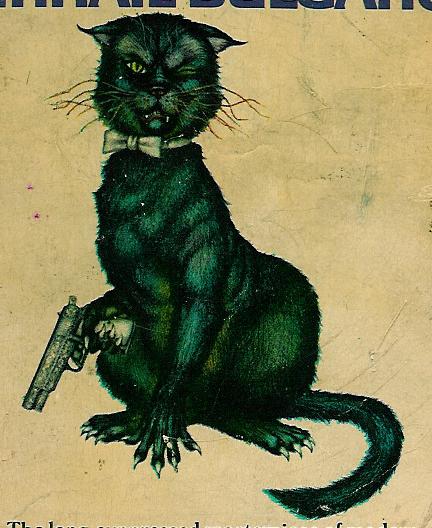
Behemoth (from the Jewish Encyclopedia)
Behemoth
Collin De Plancy- Images from Dictionnaire Infernal
Bulgakov (Library of Congress Bibliography)
Monday, December 13, 2004
Random Meanderings:
Thorstein Veblen (Theory of the Leisure Class)
Maxim Gorky
On Time:
Margaret Church (Time & Reality)
Time & Its Discontents (John Zerzan)
Thorstein Veblen (Theory of the Leisure Class)
Maxim Gorky
On Time:
Margaret Church (Time & Reality)
Time & Its Discontents (John Zerzan)
Auto-Da-Fe by Elias Canetti is a curious work. A novel that revolves around a cantankerous pedantic bibliophile will always catch my attention. Peter Kein, "the world's most famous sinologist" limits his reality to a world of Symbols, Signs, and Ideas- dry, academic, and rational.
I cannot say that the novel is gripping throughout- in fact, it was when I was not focusing on the text itself that the novel had its greatest sway over me. This statement is not vacuous double-speak. What I mean is- it was the aura of the novel, what it suggested or rather, its intima that affected me. I could not help but feel the great possibility for Tragedy (In Whitehead's sense of tragedy which "resides in the solemnity of the remorseless working of things") at each comma and every period. Ultimately, this is all borne out.
While Im aware of the socio-political interpretations of the work, I'm either too ignorant or too hard-headed (but why choose? ad*) to allow the novel to be so categorized. Instead, I like to focus it in the tradition of Huysmans and Musil- the clash of Individual and Society. But here, the impetus towards tragedy is epistemological and not sociological. (But how seperable is this?, ad)
* advocatus diaboli
Elias Canetti and Hermann Broch in conversation
I cannot say that the novel is gripping throughout- in fact, it was when I was not focusing on the text itself that the novel had its greatest sway over me. This statement is not vacuous double-speak. What I mean is- it was the aura of the novel, what it suggested or rather, its intima that affected me. I could not help but feel the great possibility for Tragedy (In Whitehead's sense of tragedy which "resides in the solemnity of the remorseless working of things") at each comma and every period. Ultimately, this is all borne out.
While Im aware of the socio-political interpretations of the work, I'm either too ignorant or too hard-headed (but why choose? ad*) to allow the novel to be so categorized. Instead, I like to focus it in the tradition of Huysmans and Musil- the clash of Individual and Society. But here, the impetus towards tragedy is epistemological and not sociological. (But how seperable is this?, ad)
* advocatus diaboli
Elias Canetti and Hermann Broch in conversation
Wednesday, December 08, 2004
Tuesday, December 07, 2004
1. Der Abentheurliche Simplicissimus Teutsch-Hans Jakob Christoffel von Grimmelshausen
2. The Anatomy of Melancholy- Robert Burton
2. The Anatomy of Melancholy- Robert Burton
I need to spend more time writing. The present conflict is whether electronic writing is the correct medium. On the one hand there is ease of use, ability to correct or erase what I now feel foolish of saying in the first place. Of course there is also the vainglory of even comtemplating that Someone Else is reading what I have to say.
I came across an interesting blog today which I must admit brought back the guilty feelings of abandoning this blog once I received a job offer last year. I must also admit that I feel some jealousy in finding that someone else finds Grimmelshausen's work as a source of inspiration (perhaps?) and entertainment (no doubt).
Gentle readers (ha!) I have found the password to this blog finally..and unless I determine to use good to honest pen and paper to chronicle my thoughts, I will update this more frequently.
For now, I leave this
I came across an interesting blog today which I must admit brought back the guilty feelings of abandoning this blog once I received a job offer last year. I must also admit that I feel some jealousy in finding that someone else finds Grimmelshausen's work as a source of inspiration (perhaps?) and entertainment (no doubt).
Gentle readers (ha!) I have found the password to this blog finally..and unless I determine to use good to honest pen and paper to chronicle my thoughts, I will update this more frequently.
For now, I leave this
Thursday, May 20, 2004
A recent point of interest has been the epistemological consequences of neo-darwinian theories of evolution. I have not thought it out sufficiently however it would seem if adaptation is supreme then one is almost forced into a position of skepticism. Then again, Im not sure that this is particular to ultra-darwinism.
Tuesday, January 20, 2004
La recherche du Lost Certainty
The middle of January, eighty cover letters, eighty cirriculum vitaes, eighty statements of purpose later. I sit here in a coffee shop having picked up Sophocles' Oedipus Rex in an attempt to forget that I have not been offered any job interviews yet. It is true that a couple have voiced interest- a telephone interview, being placed on a "long list". In the end, however, both decided to invite other candidates to campus, based on their current needs. "Based on their current needs" - the job search equivalent to "It isnt you, its me".
The middle of January, eighty cover letters, eighty cirriculum vitaes, eighty statements of purpose later. I sit here in a coffee shop having picked up Sophocles' Oedipus Rex in an attempt to forget that I have not been offered any job interviews yet. It is true that a couple have voiced interest- a telephone interview, being placed on a "long list". In the end, however, both decided to invite other candidates to campus, based on their current needs. "Based on their current needs" - the job search equivalent to "It isnt you, its me".
Saturday, January 10, 2004
I was reading an interesting article about Gore Vidal's works in the holiday issue of the New York Review of Books where in his 'Inventing A Nation', building from Benjamin Franklin's speech at the Constitutional Convention "I agree to this Constitution with all its faults.....and I believe farther that this is likely to be well administered for a Course of Years and can only end in Despotism...". Franklin's premonition was of a time where a democracy would "become too corrupt to govern themselves". Vidal argues that this Despotic Government has arrived.
However, Franklin surely was aware of the similar prophecy in Plato's Republic. And while Plato argues for the inevitable disintegration of Democracy into Despotism, it is not tied to "popular corruption" (Vidal's phrase) but instead to the 'insatiable desire' of liberty - unchecked liberty. An interesting quote from the Republic: "In a democratic country you will be told that liberty is its noblest possession..." and so "[a] democratic state may fall under the influence of unprincipled leaders, ready to minister to its thirst for liberty with too deep draughts of this heady wine".
The line of thought that Plato and Franklin/Vidal spurred me to follow was this. The seemingly disparate causes of the disintegration of democracy into despotism reflected in the quotes above are both in play today. Accordingly, "popular corruption" can be seen as a corruption of the intentions of the Founding Fathers outlined in the Federalist Papers, the Constitution etc. But his 'popular corruption' has come in the form of Ignorance. An Ignorance of the majority of Americans of the principles upon which this country was founded. In turn, it is this ignorance that has allowed the idea of unchecked liberty to be improperly placed as the cornerstone of an American identity. Plato again "In such a state the spirit of liberty is bound to go to all lengths". Ironic, but fitting, that these lengths include the USA Patriot Act and pre-emptive war.
However, Franklin surely was aware of the similar prophecy in Plato's Republic. And while Plato argues for the inevitable disintegration of Democracy into Despotism, it is not tied to "popular corruption" (Vidal's phrase) but instead to the 'insatiable desire' of liberty - unchecked liberty. An interesting quote from the Republic: "In a democratic country you will be told that liberty is its noblest possession..." and so "[a] democratic state may fall under the influence of unprincipled leaders, ready to minister to its thirst for liberty with too deep draughts of this heady wine".
The line of thought that Plato and Franklin/Vidal spurred me to follow was this. The seemingly disparate causes of the disintegration of democracy into despotism reflected in the quotes above are both in play today. Accordingly, "popular corruption" can be seen as a corruption of the intentions of the Founding Fathers outlined in the Federalist Papers, the Constitution etc. But his 'popular corruption' has come in the form of Ignorance. An Ignorance of the majority of Americans of the principles upon which this country was founded. In turn, it is this ignorance that has allowed the idea of unchecked liberty to be improperly placed as the cornerstone of an American identity. Plato again "In such a state the spirit of liberty is bound to go to all lengths". Ironic, but fitting, that these lengths include the USA Patriot Act and pre-emptive war.
Friday, January 09, 2004
Random cogitation inspired in part by Billy Collin's poem Marginalia :
and next to them, written in soft pencil-
by a beautiful girl, I could tell,
whom I would never meet-
"Pardon the egg salad stains, but I'm in love."
As well as by a library's take on Marginalia .
I must admit to often contemplating the past readers of books. As a graduate student, I would attempt to stave off cerebral marasmus by descending into the bowels of the library in search of compelling esoteria. (One of my most interesting discoveries was Monumenta Chartae Papyraceae Historiam Illustrantia- Collection of Works and Documents Illustrating the History of Paper -edited by E. J. Labarre.) On such journeys, old forgotten tomes not only revealed their authors, but in the form of marginalia, their readers - a certain lost 'social commentary' that I find particularly interesting (somwhat more interesting than say, another labyrinthine find- The Footnote: A Curious History by Anthony Grafton).
I tend to pursue these thoughts more, but for the time being the question I would like to pose is: have you ever come across any beautiful marginalia in books you have borrowed from friends or the library or adopted as lost souls? The marginalia may be beautiful due to their particular insight or contrast to the book itself, or, as in the selection from Billy Collin's poem, beautiful because it breathed the spririt of humanity.
Tuesday, August 05, 2003
La Coscienza di Zeno has been hailed as the "first psychoanalytic novel". The psuedonym Italo Svevo (meaning "Italus the Swabian") used by the author Ettore Schmitz is intergral to the story. Trieste, during Svevo's time had a interesting cultural dynamic. Politically, it was part of the Austro-Hungarian emprie. Culturally and linguistically, it was Italian, and Svevo himself was a Jew of Transylvanian descent (on his father's side). The diversity of his city Trieste, is reflected in both his pseudonym and his given name, which is characteristically both Jewish and Italian. At the end of the war, psychoanalysis was the Triestine soup de jour. Amateur diagnoses could be heard amoung the street conversations. This atmosphere is clearly one impetus for Svevo's novel. Another however, closer to home, was his brother-in-law Bruno's long but ultimately unsuccessful psychoanalytic treatment (Bruno was treated by both Viktor Tausk and Sigmund Freud, among others).
But how does Svevo accomplish his attempt at constructing a 'psychoanalytic' novel? In two ways. Psychoanalysis is first the underlying structural framework that keeps the novel progressing forward. That is, the events that unfold in the novel have been written down by Zeno in an attempt to help with his psychoanalysis. At the same time, the novel concerns itself with the practices and interpretations of psychoanalysis. Psychoanalysis is not only the foundation of the novel, but also its subject matter. These two roles sometimes clash and in the end this clashing is responsible for the existence of the novel in the first place. That is, if Zeno had not instigated the situation with Dr. S, Zeno's diaries would not have been published by Dr. S out of spite.
While there are numerous situations we can discuss here, I will limit myself to a few that, to me, portray Svevo's view of psychoanalysis. To me Zeno viewed an individual's 'quirks', 'neuroses" as the glue that held the individual together. That they were integral not impinging upon the person. On the other hand, psychoanalysis is "a science which helps to study ourselves" as Schmitz himself wrote. The role of psychoanalysis then was not 'cure' but self-awareness. One was to study the quirks and neuroses perhaps but not attempt to artifically change them. But even self awareness was a double edged sword. My favorite example here is the scene in which Zeno thinks about the numerous muscles that make up his walk. Upon consciously attending to this, he no longer can keep this muscular complexity functioning correctly and develops a limp.
Here are my answers to a few of the questions posted on a reading group I participate in.
But how does Svevo accomplish his attempt at constructing a 'psychoanalytic' novel? In two ways. Psychoanalysis is first the underlying structural framework that keeps the novel progressing forward. That is, the events that unfold in the novel have been written down by Zeno in an attempt to help with his psychoanalysis. At the same time, the novel concerns itself with the practices and interpretations of psychoanalysis. Psychoanalysis is not only the foundation of the novel, but also its subject matter. These two roles sometimes clash and in the end this clashing is responsible for the existence of the novel in the first place. That is, if Zeno had not instigated the situation with Dr. S, Zeno's diaries would not have been published by Dr. S out of spite.
While there are numerous situations we can discuss here, I will limit myself to a few that, to me, portray Svevo's view of psychoanalysis. To me Zeno viewed an individual's 'quirks', 'neuroses" as the glue that held the individual together. That they were integral not impinging upon the person. On the other hand, psychoanalysis is "a science which helps to study ourselves" as Schmitz himself wrote. The role of psychoanalysis then was not 'cure' but self-awareness. One was to study the quirks and neuroses perhaps but not attempt to artifically change them. But even self awareness was a double edged sword. My favorite example here is the scene in which Zeno thinks about the numerous muscles that make up his walk. Upon consciously attending to this, he no longer can keep this muscular complexity functioning correctly and develops a limp.
Here are my answers to a few of the questions posted on a reading group I participate in.
1. Is Zeno Cosini truly as hapless as he sometimes seems?
Zeno is hapless because he is engaged in 'psychoanalysis'- his temperment, much like Marcel in Proust's work is by disposition sensitive, insightful and yes neurotic. It is interesting to note how both Svevo and Proust take an interesting approach to "time", and I wonder how strongly/solely it has to do with the fact that both novels are individual histories of consciousness.
2. Is Zeno Cosini crazy, a genius--or both? Or neither?
Neither. Zeno is a prime example of a mind turned inward. But the more I think about it, I can see how he is both crazy and genius- that is, his ability to truly unravel a behavior, trace it backwards through associations, thoughts, actions (and when none provide themselves, cheerfully make them up), can be thought of as both genius or craziness- all depending on how functional the individual is in other ways.
3. Will Zeno Cosini ever stop reaching for that last cigarette? What is the significance of this?
Svevo himself was a horrific smoker but in Zeno I think the struggle with smoking should be seen as symbolic. He will never reach his last cigarette because smoking is a part of him, and as I said in the background, you do not seek to 'cure' yourself of these things (Of course at the time, the health implications of smoking were not of importance, and was never his reason to quit). But doesnt he mention something in the end of being able to smoke in moderation? Or am I making this up? This moderation, in effect accomplishes his goal, he is master over it.
4. Does Zeno Cosini really delude himself as often as it appears, or does he understand himself like no other, and instead turned the joke on us?
I think Zeno realizes that you can not really know yourself- (this is all said in the context of psychoanalysis)- you cannot know the unconscious (nor can the doctor) because at every turn the conscious is acting out to sabotage this- either intentionally, or altrusitically as when to help Dr. S along in his analysis, Zeno makes up memories that he thinks would confirm Dr. S hypotheses. So in this way he 'turns the joke on us'. But only _IF_ we forget the title of the novel, it is 'The (Conscience) Consciousness of Zeno' - NOT the 'Absolute Honest Truth of Zeno'. Why is this important? Well if we keep this in mind, we see the joke (and disaster) implicit in Zeno's adventure, and appreciate it nonetheless, not as history but as consciousness.
5. Is Zeno Cosini unique, or representative of people in general?
Zeno is representative of people, but perhaps unique in the breadth of his ability. Zeno ability to take psychoanalytic introspection to the extreme results in the vivid picture we get through his diary. It underlines the point: continuous thinking, introspection, "analysis" will lead to neurosis. It is not the way to health but sickness (I forget now, but Zeno's description of his wife's 'happiness' illustrates this as well). So in this way he is unique, but he is representative in that for everyone it would lead to sickness not health.
6. Zeno Cosini married Augusta while being in love with Ada. How does this dynamic change through the course of the novel, and what does it reveal about Zeno?
In its essence, the dynamic never changes but it is somewhat transferred onto Guido. The fact that Zeno 'goes to the wrong funeral' underlines that Guido was always his rival, due to his love for Ada (this is classic Freudian behavior). He appreciates Augusta for her strength in health and her loyalty. His ability to be looked upon by her family as the 'man' of the house was also important and, I think, leads to his acceptance of the situation. While his voiced views about Ada definitely change, remember we are dealing with a consciousness, and I am not convinced he would not have ran away with her if only she asked.
And more of my random comments:I agree with Anna- Zeno's problems are luxury problems. But I accept these bourgeoisie 'problems' (could psychoanalysis at the beginning of the 20th century have been examined in any other circle?) I guess what interested me was how perceptive (or seemingly so) Zeno was into his own psyche. I like 'minds turned in on themselves' novels - so I must admit I am biased here.
I like Anna's point that Zeno invents problems. And they _are_ trivial. Trivial until/if Zeno points his magnifying glass towards them (similar to Proust where 50 pages can be dedicated to his exposition of whether the lack of a warm salutation in one of Alberte's letters alludes to her assignations with women - at some point you just want to say 'hey Marcel, put the notebook down, go outside and drink some wine'). But I think that this is at least part of the point being made- even trivial, nonsensical problems can be dangerous - can turn into neuroses- if granted sufficient exposition.
Zeno cant be a tragic figure- like Anna said, his humanity hasnt been portrayed enough to be tragic- but Zeno is pathetic- caused not by his trivial problems themselves, but with Zeno's illumination of them, focus on them and attempt to 'cure' them....
Wednesday, July 30, 2003
From this 'In Focus' article from Butterflies & Wheels
Believers and theists seem to have no hesitation or diffidence whatever about assuming their beliefs are both true and synonymous with virtue, and saying as much. This is a peculiar arrangement, any way you look at it. The side that has it right, that considers evidence and logic and probablities, is politely silent. The side that has it wrong, that ignores evidence and logic and just believes, never shuts up.
This viewpoint troubles me for two reasons. If you consider 'Science' within this supposed holy grail of "evidence, logic, and probabilites", then this comment betrays at the very least a complete inability to believe, a priori.
'Science' is not a complete system by any means, it is only a method. In order for the scientific method to be used to study a given phenomena, that phenomena must be capable of meeting the prepositions of the method. These prepositions include- being observable and falsifiable. Are there not Truths which exist that cannot be predicated these? This says nothing about the validity or 'reality' of the phenomena, but only that a given method is unsuitable for its study. (BF Skinner railed against the path psychology was headed for the explicit reason that it began investigating phenomena that, in his opinion, were not subjected to the scientific method- non-observables.) The point being - if the scope of one's acceptance of is 'right' depends solely on 'evidence, logic, and probabilites', then one has not had the opportunity to truly weigh each alternative, dismissing one from the beginning not because of its inherent Truth but instead because it does not lend itself to your method of investigation.
There can be no dialogue between science and religion, because of this. Dialogue breaks down because of the limitations set up by defining "evidence" in a particular way. The only question left is whether you 'prove' one of two things in your own life- you either believe
"even when all possible scientific questions have been answered, the problems of life remain completely untouched. Of course there are then no questions left, and this itself is the answer."
or
"Dei providentia et homine confusione"
My choice? well, Im an optimist.
Believers and theists seem to have no hesitation or diffidence whatever about assuming their beliefs are both true and synonymous with virtue, and saying as much. This is a peculiar arrangement, any way you look at it. The side that has it right, that considers evidence and logic and probablities, is politely silent. The side that has it wrong, that ignores evidence and logic and just believes, never shuts up.
This viewpoint troubles me for two reasons. If you consider 'Science' within this supposed holy grail of "evidence, logic, and probabilites", then this comment betrays at the very least a complete inability to believe, a priori.
'Science' is not a complete system by any means, it is only a method. In order for the scientific method to be used to study a given phenomena, that phenomena must be capable of meeting the prepositions of the method. These prepositions include- being observable and falsifiable. Are there not Truths which exist that cannot be predicated these? This says nothing about the validity or 'reality' of the phenomena, but only that a given method is unsuitable for its study. (BF Skinner railed against the path psychology was headed for the explicit reason that it began investigating phenomena that, in his opinion, were not subjected to the scientific method- non-observables.) The point being - if the scope of one's acceptance of is 'right' depends solely on 'evidence, logic, and probabilites', then one has not had the opportunity to truly weigh each alternative, dismissing one from the beginning not because of its inherent Truth but instead because it does not lend itself to your method of investigation.
There can be no dialogue between science and religion, because of this. Dialogue breaks down because of the limitations set up by defining "evidence" in a particular way. The only question left is whether you 'prove' one of two things in your own life- you either believe
"even when all possible scientific questions have been answered, the problems of life remain completely untouched. Of course there are then no questions left, and this itself is the answer."
or
"Dei providentia et homine confusione"
My choice? well, Im an optimist.
Tuesday, July 22, 2003
James Joyce called his work Dubliners "to betray the soul of that hemiplegia or paralysis which many consider a city". It is this paralysis - spiritual and moral - that concerns Joyce here. The work itself has been subjected to numerous analyses, pointing out the stories' intertwined nature, parallels to Homer, Dantean levels of approach. As Joyce himself said, the stories are grouped by "four of its aspects: childhood, adolescence, maturity, and public life". This implies a linear progression, one however I think should be resisted by the reader in order to see how cyclical, how turned in upon itself, the work is.
To begin, one can read the opening story as a prelude to all that are to come:
The opening story, "The Sisters" chronicles the death of an elderly priest in whom we are given the first glance of "paralysis". In this priest we have morality/spirituality and worldliness juxtaposed, and in constant tension. The priest’s hemiplegia (paralysis of one side of the body) has affected his faith: "It was the chalice that he broke...that was the beginning of it". While morality lies there prostrate, worldliness abounds. The “constant showers of snuff” coincide with the greening of his “ancient priestly garments”. Joyce further illuminates this paralysis when the boy takes a Dantean journey in his dreams. He meets the priest's "grey face" and realizes his own smile is an attempt "to absolve the simoniac of his sin". The simony participated in by the priest was the peddling of his own soul.
The gravity of the symbol offered by Joyce is summed up by Old Cotter’s remark about the priest: “There was something uncanny about him...”. According to Freud, “everything is unheimlich (uncanny) that ought to have remained secret and hidden but has come to life”. And this is where Joyce constructs the framework for the rest of the stories. The uncanniness that should have remained hidden is humanity’s subjugating, paralyzing, the moral side of Being for the benefit of the other, worldly side. The consequence of allowing this hemiplegia to occur, to come to light in the symbol of this priest, is personified in the boy’s discovering “a sensation of freedom as if I had been freed from something by his death”.
The death, one may postulate, came well before the actual moment his heart stopped beating- it came when his priestly garb became snuff-stained. But this exchange, spiritual for worldly, is not reserved for the priest alone. Instead, in the symbol of the priest we are given the framework for interpreting the rest of the stories. We are to watch the resultant spiritual and moral hemiplegia that comes from being "freed from something".
We are reminded of the connectivity of this story to those that follow by Joyce himself. In ‘An Encounter’ we are told that Joe Dillon had a “vocation for the priesthood”. In ‘Araby’, the former tenant of the house was a priest, one who died in the back drawing-room. In ‘Eveline’ there is a yellowed photograph of a priest hanging on the wall. The priest from ‘The Sisters’ looms in the background of Dublin throughout these stories. This inter-connectivity is as important as any of the individual stories.
The most ingenious of these connections, for me is Joyce’s entitling the last story, ‘The Dead’. This entitling accomplishes two things. First, it completes the circumference of the circle started by the initial story. That is, the titles of the first and last stories are interchangeable. However, if Joyce had swapped titles, the connection would not have been as apparent. The similarities between these stories makes one wonder whether the boy of the first story could not have been a younger Gabriel. The work does not support this claim but this is not of importance. The importance is that the claim surfaces in the reader’s mind so that, once again the cyclical nature of the work comes to light.
The second thing accomplished by the ‘The Dead’ was to provide a subtitle to the work as a whole. ‘The Dead’ refer to the victims of various tints of hemiplegia; the living dead of Dublin- who continue to live aimlessly, those who have not gone “boldly into that other world, in the full glory of some passion”. These living Dead are all present at the party given by ‘the sisters’. It is at this party we see the culmination of the decline Joyce has been describing in his stories. In Gabriel, we have either a sign of hope (his epiphany) or despair (his resignation acceptance).
The ambiance of ‘Dubliners’, the rich moist soil Joyce cultivates is best summed up by the boy in the story ‘Araby’: “I saw myself as a creature driven and derided by vanity; and my eyes burned with anguish and anger”.
This is a wonderful collection of stories, that each do their part to make up one unified whole.
4 Stars.
To begin, one can read the opening story as a prelude to all that are to come:
The opening story, "The Sisters" chronicles the death of an elderly priest in whom we are given the first glance of "paralysis". In this priest we have morality/spirituality and worldliness juxtaposed, and in constant tension. The priest’s hemiplegia (paralysis of one side of the body) has affected his faith: "It was the chalice that he broke...that was the beginning of it". While morality lies there prostrate, worldliness abounds. The “constant showers of snuff” coincide with the greening of his “ancient priestly garments”. Joyce further illuminates this paralysis when the boy takes a Dantean journey in his dreams. He meets the priest's "grey face" and realizes his own smile is an attempt "to absolve the simoniac of his sin". The simony participated in by the priest was the peddling of his own soul.
The gravity of the symbol offered by Joyce is summed up by Old Cotter’s remark about the priest: “There was something uncanny about him...”. According to Freud, “everything is unheimlich (uncanny) that ought to have remained secret and hidden but has come to life”. And this is where Joyce constructs the framework for the rest of the stories. The uncanniness that should have remained hidden is humanity’s subjugating, paralyzing, the moral side of Being for the benefit of the other, worldly side. The consequence of allowing this hemiplegia to occur, to come to light in the symbol of this priest, is personified in the boy’s discovering “a sensation of freedom as if I had been freed from something by his death”.
The death, one may postulate, came well before the actual moment his heart stopped beating- it came when his priestly garb became snuff-stained. But this exchange, spiritual for worldly, is not reserved for the priest alone. Instead, in the symbol of the priest we are given the framework for interpreting the rest of the stories. We are to watch the resultant spiritual and moral hemiplegia that comes from being "freed from something".
We are reminded of the connectivity of this story to those that follow by Joyce himself. In ‘An Encounter’ we are told that Joe Dillon had a “vocation for the priesthood”. In ‘Araby’, the former tenant of the house was a priest, one who died in the back drawing-room. In ‘Eveline’ there is a yellowed photograph of a priest hanging on the wall. The priest from ‘The Sisters’ looms in the background of Dublin throughout these stories. This inter-connectivity is as important as any of the individual stories.
The most ingenious of these connections, for me is Joyce’s entitling the last story, ‘The Dead’. This entitling accomplishes two things. First, it completes the circumference of the circle started by the initial story. That is, the titles of the first and last stories are interchangeable. However, if Joyce had swapped titles, the connection would not have been as apparent. The similarities between these stories makes one wonder whether the boy of the first story could not have been a younger Gabriel. The work does not support this claim but this is not of importance. The importance is that the claim surfaces in the reader’s mind so that, once again the cyclical nature of the work comes to light.
The second thing accomplished by the ‘The Dead’ was to provide a subtitle to the work as a whole. ‘The Dead’ refer to the victims of various tints of hemiplegia; the living dead of Dublin- who continue to live aimlessly, those who have not gone “boldly into that other world, in the full glory of some passion”. These living Dead are all present at the party given by ‘the sisters’. It is at this party we see the culmination of the decline Joyce has been describing in his stories. In Gabriel, we have either a sign of hope (his epiphany) or despair (his resignation acceptance).
The ambiance of ‘Dubliners’, the rich moist soil Joyce cultivates is best summed up by the boy in the story ‘Araby’: “I saw myself as a creature driven and derided by vanity; and my eyes burned with anguish and anger”.
This is a wonderful collection of stories, that each do their part to make up one unified whole.
4 Stars.
Tuesday, July 15, 2003
Two things that utterly depressed me this week:
1) Reading D. Dennett's NY Times Op-Ed The Bright Stuff. I really do wish this is in jest. The coining of the term 'Brights" is well, not so bright. First, like so much academic bs, it attempts to rehash and recirculate old ideas under a new banner. Richard Dawkins talks about it here in terms of its ability to "recognise the power and importance of consciousness-raising". Raising the consciousness of what? Well, that there are people who do not believe in God *gasp*, no shit? But for one reason or another do not like the term 'agnostic' or 'atheist'.
Dawkins remarks "Brights constitute 60% of American scientists, and a stunning 93% of those scientists good enough to be elected to the elite National Academy of Sciences (equivalent to Fellows of the Royal Society) are brights." Im not sure where this statistic came from, but doesnt it seem relevant to point out that materialists (in the true sense of the term) would be more likely to become scientists in todays age? If rational materialism is all you have, you surely arent going to be a theologian, now are you? While a belief in diety may make you less likely to invest your whole life into materialistic endeavors (PS. for all you sour-grapes people, I have a PhD and work in a medical school). Just a thought, Im probably wrong.
The terms itself is rather ridiculous in that it implies that if you dont believe in diety or the supernatural (or have those leanings- since Im not really sure where the dividing line for bright and non-bright is) then you are 'bright' - even if the coiners of the term insist that it should be used solely as a noun. By this definition then, I guess Ive met droves of not-so-bright brights.
Speaking about ridiculous, couldnt they come up with anything better than "bright"? Sounds like something that should instead be found in Burgess's A Clockwork Orange
Im not sure that the fact people dont believe in God needs conscious-raising either. All around us we have evidence of this. This seems to be really based on the inability of most people to understand what the separation of Church and State really implies. Most instead reduce this to something they can get their limited intellects around- "If religion/god is mentioned in/around/about a public place/event/thing, then cry but what about separation of church and state?" But thats another story.
I think if anything, someone needs to coin the term "Brighter" - membership based solely on the ability to recognize the idiocy of the term "bright" (yes, I see the irony).
As Dawkins said, "words are not trivial" - think twice before signing on.
2) The Bush Administration's use of military tribunals for terrorist suspects (The Economist's Unjust, unwise, unAmerican) - I cannot say it any better than this- it is a scary time in the US. These "military commissions" will judge these people innocent until proven guilty beyond a reasonable doubt, will be given the right not to testify against themselves, and have open trials- but as The Economist points out, these are not 'rights' byt 'priveledges' that are being granted by the Commissions, and can be revoked without any ability of interference by any other branch of the government.
1) Reading D. Dennett's NY Times Op-Ed The Bright Stuff. I really do wish this is in jest. The coining of the term 'Brights" is well, not so bright. First, like so much academic bs, it attempts to rehash and recirculate old ideas under a new banner. Richard Dawkins talks about it here in terms of its ability to "recognise the power and importance of consciousness-raising". Raising the consciousness of what? Well, that there are people who do not believe in God *gasp*, no shit? But for one reason or another do not like the term 'agnostic' or 'atheist'.
Dawkins remarks "Brights constitute 60% of American scientists, and a stunning 93% of those scientists good enough to be elected to the elite National Academy of Sciences (equivalent to Fellows of the Royal Society) are brights." Im not sure where this statistic came from, but doesnt it seem relevant to point out that materialists (in the true sense of the term) would be more likely to become scientists in todays age? If rational materialism is all you have, you surely arent going to be a theologian, now are you? While a belief in diety may make you less likely to invest your whole life into materialistic endeavors (PS. for all you sour-grapes people, I have a PhD and work in a medical school). Just a thought, Im probably wrong.
The terms itself is rather ridiculous in that it implies that if you dont believe in diety or the supernatural (or have those leanings- since Im not really sure where the dividing line for bright and non-bright is) then you are 'bright' - even if the coiners of the term insist that it should be used solely as a noun. By this definition then, I guess Ive met droves of not-so-bright brights.
Speaking about ridiculous, couldnt they come up with anything better than "bright"? Sounds like something that should instead be found in Burgess's A Clockwork Orange
Im not sure that the fact people dont believe in God needs conscious-raising either. All around us we have evidence of this. This seems to be really based on the inability of most people to understand what the separation of Church and State really implies. Most instead reduce this to something they can get their limited intellects around- "If religion/god is mentioned in/around/about a public place/event/thing, then cry but what about separation of church and state?" But thats another story.
I think if anything, someone needs to coin the term "Brighter" - membership based solely on the ability to recognize the idiocy of the term "bright" (yes, I see the irony).
As Dawkins said, "words are not trivial" - think twice before signing on.
2) The Bush Administration's use of military tribunals for terrorist suspects (The Economist's Unjust, unwise, unAmerican) - I cannot say it any better than this- it is a scary time in the US. These "military commissions" will judge these people innocent until proven guilty beyond a reasonable doubt, will be given the right not to testify against themselves, and have open trials- but as The Economist points out, these are not 'rights' byt 'priveledges' that are being granted by the Commissions, and can be revoked without any ability of interference by any other branch of the government.
Monday, July 14, 2003
Thursday, July 10, 2003
Im currently reading Frederick Buechner's Godric and finally finishing up the last 500 pages of Proust's À La Recherche Du Temps Perdu. While Godric so far seems interesting, I do not like it half as much as The Book of Bebb tetralogy- some enjoy Godric's dialect- but I find it difficult to wade through. I wont say more until I finish it up.
Proust, Ive been reading on and off for 2 1/2 years- its about time I finish it.
Proust, Ive been reading on and off for 2 1/2 years- its about time I finish it.
Tuesday, July 08, 2003
I have just finished reading Thomas Hardy's Jude the Obscure (You can find the entire online here). This novel was one of the most distressing pieces of work I have ever read. It is little effort to understand the type of reception it must have received in England in the late 1800's. Most telling was Hardy's vexation at criticism, that he decided not to write another novel but instead focused on poetry (or so the story goes).
To save space, a brief synopsis of the novel can be had here
In this social, but also psychological, novel Hardy explores the limitations placed on both social advancement and love by society and its mores. Hardy keeps ambition and social class as well as love and institutional sanction in constant opposition.
Im not sure I completely acccept the interpretation that Sue was a victim of her times- her 'moral' outlook on love vs. marriage defeated, in the end, by society and their harsh condemnation of her attempt to buck status quo. There is a certain fickleness in her that I am all too familar with - and surely my familiarity does not rely on times where a woman crying out against the unfairness of society (as unfair as it may be). But then again, who knows. At least, she is very fragile psychologically- the question remaining is whether her fragility was a consequence of her tragic struggle against soceity, or her struggle against society a tragic consequence of her psychological fragility. Like almost everything in life, its probably a cocktail of the pair.
What grips me the most is Hardy's depiction of 'love'. On the continuum of Society's ability to dicate, shape, and define love, each of the four characters represent some point of acquiescence. Arabella, ever the practical, accepts society's proscriptions, that is, unless they become obstacles towards her advancement. This stance cause little dissonance because morals are subserviant to gain and social appearances. The other extreme is not as easily definable - either Jude or Sue.
While both theoretically reject society's yolk - they do so from different perspectives-
Sue sees the potential exquisiteness of a relationship between herself and Jude- one that transcends the usual human attachment between male and female- on a visible level one that successfully eschews the physical in preference for the metaphysical:
'There was a Being whom my spirit oft
Met on its visioned wanderings far aloft ...
A seraph of Heaven, too gentle to be human,
Veiling beneath that radiant form of woman.'
(from Shelley's Epipsychidion)
Jude, on the other hand, a view not as noble, simply sees the rigidity of social proscription- the asininity of requiring two human individuals, dynamic and changing, to vow eternal love for each other. Here Jude is closer in some respects to Shelley's Romanticism (as is his romantic ideal of Christminster).
In both cases, Hardy shows how forlorn Romanticism is in a Victorian age
What hits home for me, is Hardy's exposing, in all its nakedness the gulf that can separate love and happiness. Both Jude and Sue love with an intensity that does hark back to Romanticism, yet neither are happy.
To save space, a brief synopsis of the novel can be had here
In this social, but also psychological, novel Hardy explores the limitations placed on both social advancement and love by society and its mores. Hardy keeps ambition and social class as well as love and institutional sanction in constant opposition.
Im not sure I completely acccept the interpretation that Sue was a victim of her times- her 'moral' outlook on love vs. marriage defeated, in the end, by society and their harsh condemnation of her attempt to buck status quo. There is a certain fickleness in her that I am all too familar with - and surely my familiarity does not rely on times where a woman crying out against the unfairness of society (as unfair as it may be). But then again, who knows. At least, she is very fragile psychologically- the question remaining is whether her fragility was a consequence of her tragic struggle against soceity, or her struggle against society a tragic consequence of her psychological fragility. Like almost everything in life, its probably a cocktail of the pair.
What grips me the most is Hardy's depiction of 'love'. On the continuum of Society's ability to dicate, shape, and define love, each of the four characters represent some point of acquiescence. Arabella, ever the practical, accepts society's proscriptions, that is, unless they become obstacles towards her advancement. This stance cause little dissonance because morals are subserviant to gain and social appearances. The other extreme is not as easily definable - either Jude or Sue.
While both theoretically reject society's yolk - they do so from different perspectives-
Sue sees the potential exquisiteness of a relationship between herself and Jude- one that transcends the usual human attachment between male and female- on a visible level one that successfully eschews the physical in preference for the metaphysical:
'There was a Being whom my spirit oft
Met on its visioned wanderings far aloft ...
A seraph of Heaven, too gentle to be human,
Veiling beneath that radiant form of woman.'
(from Shelley's Epipsychidion)
Jude, on the other hand, a view not as noble, simply sees the rigidity of social proscription- the asininity of requiring two human individuals, dynamic and changing, to vow eternal love for each other. Here Jude is closer in some respects to Shelley's Romanticism (as is his romantic ideal of Christminster).
In both cases, Hardy shows how forlorn Romanticism is in a Victorian age
What hits home for me, is Hardy's exposing, in all its nakedness the gulf that can separate love and happiness. Both Jude and Sue love with an intensity that does hark back to Romanticism, yet neither are happy.
Monday, July 07, 2003
The poet John Keats coined the term Negative Capability - to describe a state in which a person
"is capable of being in uncertainties, Mysteries, doubts, without any irritable reaching after fact & reason"
Novelists such as Frederick Buechner, John Irving, Shusako Endo, and Robertson Davies utilize this concept in attempting to illuminate humanity's minuet between faith and unfaith.
(more later)
"is capable of being in uncertainties, Mysteries, doubts, without any irritable reaching after fact & reason"
Novelists such as Frederick Buechner, John Irving, Shusako Endo, and Robertson Davies utilize this concept in attempting to illuminate humanity's minuet between faith and unfaith.
(more later)
Thursday, July 03, 2003
We are all, at best, mostly Fifth Business - like it or not. The title of Robertson Davies' first book of the Deptford Trilogy painstakingly points a finger at this but at the same time rejoices in the necessity of such roles, even to the point of easily convincing the readers that is it a more enviable role than Hero, Heroine, or Villain. Unfortunately, for the reader, we are given a definition before the book begins:
Those roles which, being neither those of Hero nor Heroine, Confidante nor Villain, but which were nonetheless essential to bring about the Recognition or the denouement, were called the Fifth Business in drama and opera companies...the player who acted these parts was often referred to as Fifth Business
I would rather have allowed readers to stumble upon the meaning of the rather enigmatic title in the conversation between Dunstan and Liesl- where the title's relevance gives one pause and invites us to reflect back and realise how Dunstan truly is Fifth Business even while accepting his rather unique accomplishments. Indeed, if Dunstan didnt take it upon himself to write what we are reading, all that would have been left in print about him was the "idiotic piece that appeared in the College Chronicle". While I am sure I missed the more subtle insights Davies offers us into the Canadian psyche, it seems that he suggests a deep-rooted social unconsciousness in which Canada views itself as Fifth Business
There are also the religious/mythological themes of the novel which left an impression on me. Eisengrim and Liesl want to establish a troupe that will be an outlet for humanity's "concealed longing ... for romance and marvels" P
People simply want to marvel at something but unfortunately live in a world where "the whole spirit of our time is not to let them do it".
Magic entertwined with mythology substitutes for religion and God which have been pushed out by facts and reason. I think it is only from a European mindset (not defined geographically) that this necessity could be identified. The unique European position - the ability to feel the continuity of time, of Western Civilization in a way that is not available to non-Europeans. This is personified in Liesl:
"Oh, this Christianity! Even when people swear that they don't believe in it, the fifteen hundred years of Christianity that has made our world is in their bones, and they want to show they can be Christians without Christ".
Another point of interest:
" I have not yet found a God to teach me how to be old" Dunston says, referring to an earlier conversation with the likeable old Jesuit Padre Blazon where Blazon remarked
" Very well, am I at fault for wanting a Christ who will show me how to be an old man? All Christ's teaching is put forward with the dogmatism, the certainty, and the strength of youth: I need something that takes account of the accretion of experience, the sense of paradox and ambiguity that comes with years!" While these remarks beg me to question whether Blazon really knew Christ, the focus should be how experience brings paradox and ambiguity - for some this may make it easy to identify what should be marveled at, others it makes it more difficult. Nevertheless, to me it seems that Blazon is calling out for the capacity of Negative Capability (which I will write about next).
Finally:
Liesl tells Dunston that "... every man has a devil... you must get to know your personal devil. You must even get to know his father, the Old Devil". When Dunston relates this to Blazon, the Padre has this to say "I find no fault with that. The Devil knows corners of us all of which Christ Himself is ignorant. Indeed, I am sure Christ learned a great deal that was salutary about Himself when He met the Devil in the wilderness" Therefore, if this can have such a cathartic effect, "Why dont you shake hands with your devil" -- this isnt for everyone, Liesl admits "Only for the twice-born". Of course, the twice-born are easily set apart in Fifth Business as those transformed by name, Dunstable, Percy and Paul (thrice)... are all twice-born - as Dunston, Boy, Magnus (Paul actually is thrice born, adding Faustus).
This is all quite Jungian in its depiction of both God and the Devil as psychological realities- both of which must be explored in order for a human being to be whole.
The question remains who attempted to shake hands with their devils? But this is a question I am not willing to answer until I have finished the trilogy
And of course I havent even mentioned Mrs Dempster, by design- because I have still not completely puzzled her out - saint, fool or merely more fifth business?
Those roles which, being neither those of Hero nor Heroine, Confidante nor Villain, but which were nonetheless essential to bring about the Recognition or the denouement, were called the Fifth Business in drama and opera companies...the player who acted these parts was often referred to as Fifth Business
I would rather have allowed readers to stumble upon the meaning of the rather enigmatic title in the conversation between Dunstan and Liesl- where the title's relevance gives one pause and invites us to reflect back and realise how Dunstan truly is Fifth Business even while accepting his rather unique accomplishments. Indeed, if Dunstan didnt take it upon himself to write what we are reading, all that would have been left in print about him was the "idiotic piece that appeared in the College Chronicle". While I am sure I missed the more subtle insights Davies offers us into the Canadian psyche, it seems that he suggests a deep-rooted social unconsciousness in which Canada views itself as Fifth Business
There are also the religious/mythological themes of the novel which left an impression on me. Eisengrim and Liesl want to establish a troupe that will be an outlet for humanity's "concealed longing ... for romance and marvels" P
People simply want to marvel at something but unfortunately live in a world where "the whole spirit of our time is not to let them do it".
Magic entertwined with mythology substitutes for religion and God which have been pushed out by facts and reason. I think it is only from a European mindset (not defined geographically) that this necessity could be identified. The unique European position - the ability to feel the continuity of time, of Western Civilization in a way that is not available to non-Europeans. This is personified in Liesl:
"Oh, this Christianity! Even when people swear that they don't believe in it, the fifteen hundred years of Christianity that has made our world is in their bones, and they want to show they can be Christians without Christ".
Another point of interest:
" I have not yet found a God to teach me how to be old" Dunston says, referring to an earlier conversation with the likeable old Jesuit Padre Blazon where Blazon remarked
" Very well, am I at fault for wanting a Christ who will show me how to be an old man? All Christ's teaching is put forward with the dogmatism, the certainty, and the strength of youth: I need something that takes account of the accretion of experience, the sense of paradox and ambiguity that comes with years!" While these remarks beg me to question whether Blazon really knew Christ, the focus should be how experience brings paradox and ambiguity - for some this may make it easy to identify what should be marveled at, others it makes it more difficult. Nevertheless, to me it seems that Blazon is calling out for the capacity of Negative Capability (which I will write about next).
Finally:
Liesl tells Dunston that "... every man has a devil... you must get to know your personal devil. You must even get to know his father, the Old Devil". When Dunston relates this to Blazon, the Padre has this to say "I find no fault with that. The Devil knows corners of us all of which Christ Himself is ignorant. Indeed, I am sure Christ learned a great deal that was salutary about Himself when He met the Devil in the wilderness" Therefore, if this can have such a cathartic effect, "Why dont you shake hands with your devil" -- this isnt for everyone, Liesl admits "Only for the twice-born". Of course, the twice-born are easily set apart in Fifth Business as those transformed by name, Dunstable, Percy and Paul (thrice)... are all twice-born - as Dunston, Boy, Magnus (Paul actually is thrice born, adding Faustus).
This is all quite Jungian in its depiction of both God and the Devil as psychological realities- both of which must be explored in order for a human being to be whole.
The question remains who attempted to shake hands with their devils? But this is a question I am not willing to answer until I have finished the trilogy
And of course I havent even mentioned Mrs Dempster, by design- because I have still not completely puzzled her out - saint, fool or merely more fifth business?
Friday, June 27, 2003
These are some comments I posted elsewhere but wanted to keep.. so here they are, enjoy.
Ah, Huysman's A Rebours a strange book indeed which in its grocery list aspect reminds me of Brett Easton Ellis's American Psycho. However, I did enjoy this book- perhaps because I read it around the same time as reading Musil's The Man Without Qualities and the first volume of the 3-volume edition of Proust's A la recherche du temps perdu
In Musil's creation, the protagonist is almost suffocated (or completely freed, depending on your viewpoint) with the tremendous 'Possibility' created by the modern world, the consequence of this being the inability to perceive any sense of reality (which can be viewed as proscription on possiblity). This results in seeing himself as a man without qualities. He generally accepts this situation, and carries on predictably.
I saw Des Esseintes attempt to reject the modern world and instead live in a created world as the logical-philosophical extention of Musil (regardless of its earlier date). Instead, however, of accepting the existential dilemma created by the modern condition, Des Esseintes rejects the modern world, and attempts to construct a reality of his own. With a sense of reality, possiblity is contrained -making perhaps, life livable. But as we see in the end, man cannot be estranged in this way, reality cannot this way be constructed and Des Esseintes is forced back into society. This reminds me of Samuel Beckett's famous quote about the book (to paraphrase) -that after writing a book like that, the only options were either the barrel of a gun, or the foot of a cross. Either reality is completely suppressed by possiblity whereby you choose the gun, or there is an overarching reality -namely theological- and you choose the cross. (indeed, in life, Huysman did choose the cross)
Huysman took the extreme reaction to the modern world by attempting to reject it,and if we view Huysman as the extention of Des Esseintes, - was sucessful in finding reality (i.e. the limit of possiblity) in God. While Musil, perhaps aware of the futility of the secular extreme, gives us a character who attempts to live in society but who would, if it was possible, rather reject it completely as Des Esseintes did. Instead, he is left to float shapelessly - even while the great catalystic events of World War I occur.
Anyhow, I guess this is why I really liked the book, in this context- whether I am right or wrong in my interpretation. But then I always tend to like books that are consumed with ideas.
Ah, Huysman's A Rebours a strange book indeed which in its grocery list aspect reminds me of Brett Easton Ellis's American Psycho. However, I did enjoy this book- perhaps because I read it around the same time as reading Musil's The Man Without Qualities and the first volume of the 3-volume edition of Proust's A la recherche du temps perdu
In Musil's creation, the protagonist is almost suffocated (or completely freed, depending on your viewpoint) with the tremendous 'Possibility' created by the modern world, the consequence of this being the inability to perceive any sense of reality (which can be viewed as proscription on possiblity). This results in seeing himself as a man without qualities. He generally accepts this situation, and carries on predictably.
I saw Des Esseintes attempt to reject the modern world and instead live in a created world as the logical-philosophical extention of Musil (regardless of its earlier date). Instead, however, of accepting the existential dilemma created by the modern condition, Des Esseintes rejects the modern world, and attempts to construct a reality of his own. With a sense of reality, possiblity is contrained -making perhaps, life livable. But as we see in the end, man cannot be estranged in this way, reality cannot this way be constructed and Des Esseintes is forced back into society. This reminds me of Samuel Beckett's famous quote about the book (to paraphrase) -that after writing a book like that, the only options were either the barrel of a gun, or the foot of a cross. Either reality is completely suppressed by possiblity whereby you choose the gun, or there is an overarching reality -namely theological- and you choose the cross. (indeed, in life, Huysman did choose the cross)
Huysman took the extreme reaction to the modern world by attempting to reject it,and if we view Huysman as the extention of Des Esseintes, - was sucessful in finding reality (i.e. the limit of possiblity) in God. While Musil, perhaps aware of the futility of the secular extreme, gives us a character who attempts to live in society but who would, if it was possible, rather reject it completely as Des Esseintes did. Instead, he is left to float shapelessly - even while the great catalystic events of World War I occur.
Anyhow, I guess this is why I really liked the book, in this context- whether I am right or wrong in my interpretation. But then I always tend to like books that are consumed with ideas.
Friday, August 23, 2002
I was reading this article by Stephen Silver on Blogcritics.org. Blech! the same old reactionary critique to music that (for better or for worse) wears its influences on shirt-sleeves. Im quite jaded, but the Those in the Know rail against the Strokes, the Vines, the Hives, and to a lesser degree the White Stripes for their lack of musical 'originality', or 'skill' is getting to me. They chuckle at the media's take on the these bands as "Saving Roll -n- Roll" - often parroting the tired comments strewn throughout this critic's piece, "How can that be saving rock, when its nothing but re-hashed 60s garage filtered through punk...." (mixed with whatever else they think makes them seem witty and truly one of Those in the Know). If originality was the only criterion for why I listen to music, then half of my music collection would have to be thrown out. These bands are not "Saving Rock" for Those in the Know, these bands are saving rock for the majority of people, who, at sea, are rapidly sinking above the USS Nu Metal or as an alternative the USS Singing Tits-n-Ass. How is Rock being saved? Well, of course 'saving' is the wrong word. But it sounds dramatic enough for a snazzy magazine article. If it is from stagnation that Rock needs to be saved, then the Vines and their ilk won't do it. Who knows where the next truly original injection into rock n roll is going to come from. But until then, it needs to be kept on the radar. And this is what I mean when I say these bands are saving Rock-n-Roll. They are offering the masses an alternative to the sinking ships. And in this capacity, Who cares if the music is 'unoriginal'- it is pure rawk...it makes me want to move my ass.
Thursday, August 22, 2002
Ok, well here are some thoughts that I had while listening to David Bowie's masterpiece- The Rise and Fall of Ziggy Stardust and the Spiders from
Mars. The thoughts are by no means cohesive. Instead, a stream of consciousness- neuronal blips that crossed my radar while listening. First, I
would say there is no better 'big' record than Ziggy- none, whatsoever (and no I havent heard everything, and no I do not care). What the hell is 'big', you dare
ask- Well, can I have a run at defining 'obscene' instead? Or perhaps give examples rather than a definition- but then the problem of induction would
remain. A similarly afflicted (read: musically addicted) friend and I were having this conversation the other day. We threw around adjectives in an attempt
to grasp at its meaning: 'full', 'big'. We agreed that Ziggy belonged to it, she made a case for Neutral Milk Hotel as well. On CMJ, a simliar
attempt was made to categorize (boo!!!, you say, I know) another (related?) 'type' of music- phrases such as Epic Pop, Orchestral Pop, Chamber Pop were
bandied about. But were these definitions based on the number of instruments used? The sheer magnitude of acoustic output? This is not what I had in mind. It
is not acoustic in nature, but perceptual. It has less to do with the acoustic properties of the stimulus than the perceptual/cognitive reactions it
evokes. The physical-perceptual link is often not linear. Instead, small acoustic events can often induce enormous perceptions.
It is this perceptual reaction that I refer to. Perceptually, Ziggy is big. Should I rely on a more linguistically opaque term than 'big'? What does it matter?
the phenomena to which I refer remains the same. Not to mention, as perception is highly subjective, I am offered a loop-hole when confronted with opposing opinion.
To me, Ziggy is big. Oh right, The Rise and Fall of Ziggy Stardust and the Spiders from Mars. Maybe I will talk about that next time.
Mars. The thoughts are by no means cohesive. Instead, a stream of consciousness- neuronal blips that crossed my radar while listening. First, I
would say there is no better 'big' record than Ziggy- none, whatsoever (and no I havent heard everything, and no I do not care). What the hell is 'big', you dare
ask- Well, can I have a run at defining 'obscene' instead? Or perhaps give examples rather than a definition- but then the problem of induction would
remain. A similarly afflicted (read: musically addicted) friend and I were having this conversation the other day. We threw around adjectives in an attempt
to grasp at its meaning: 'full', 'big'. We agreed that Ziggy belonged to it, she made a case for Neutral Milk Hotel as well. On CMJ, a simliar
attempt was made to categorize (boo!!!, you say, I know) another (related?) 'type' of music- phrases such as Epic Pop, Orchestral Pop, Chamber Pop were
bandied about. But were these definitions based on the number of instruments used? The sheer magnitude of acoustic output? This is not what I had in mind. It
is not acoustic in nature, but perceptual. It has less to do with the acoustic properties of the stimulus than the perceptual/cognitive reactions it
evokes. The physical-perceptual link is often not linear. Instead, small acoustic events can often induce enormous perceptions.
It is this perceptual reaction that I refer to. Perceptually, Ziggy is big. Should I rely on a more linguistically opaque term than 'big'? What does it matter?
the phenomena to which I refer remains the same. Not to mention, as perception is highly subjective, I am offered a loop-hole when confronted with opposing opinion.
To me, Ziggy is big. Oh right, The Rise and Fall of Ziggy Stardust and the Spiders from Mars. Maybe I will talk about that next time.
Subscribe to:
Comments (Atom)