Thursday, December 16, 2004

Mikhail Bulgakov- The Master and Margarita

C'est l'une des plus subtiles ruses du malin
que d'avoir incité ceux qu'il ourmentait a douter de son existence...

- Baudelaire
Master and Margarita Texts
Original text (in Russian)- with illustrations
Michael Glenny translation
Richard Pevear and Larissa Volokhonsky translation

Annotated Guides
Kevin Moss's (Middlebury College) Web-based Annotated Guide

Other works associated with M & M
Goethe's Faust (Charles Brooks trans.)
Goethe's Faust (Bayard Taylor trans.)
Gounod's Faust
Farrar's Life of Jesus Christ
Renan's The Life of Jesus
Gospel of Nicodemus
Death of Pilate (Apocrypha)


Azazello (Azazel)

Azazel
Azazel (from the Jewish Encyclopedia)
The Book of Enoch

Behemoth (Begemot)
Behemoth, the most amiable character of Woland's retinue.
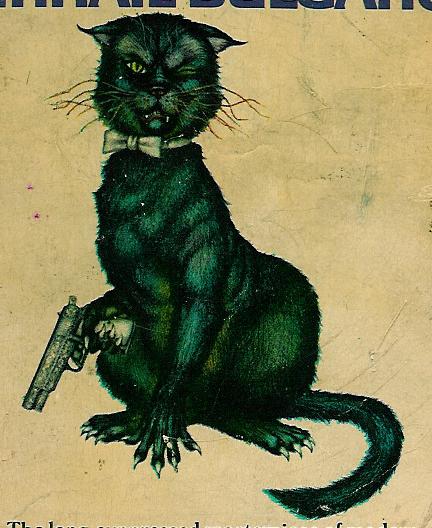
Behemoth (from the Jewish Encyclopedia)
Behemoth

Collin De Plancy- Images from Dictionnaire Infernal

Bulgakov (Library of Congress Bibliography)

Monday, December 13, 2004

Random Meanderings:

Thorstein Veblen (Theory of the Leisure Class)

Maxim Gorky


On Time:
Margaret Church (Time & Reality)

Time & Its Discontents (John Zerzan)
Auto-Da-Fe by Elias Canetti is a curious work. A novel that revolves around a cantankerous pedantic bibliophile will always catch my attention. Peter Kein, "the world's most famous sinologist" limits his reality to a world of Symbols, Signs, and Ideas- dry, academic, and rational.

I cannot say that the novel is gripping throughout- in fact, it was when I was not focusing on the text itself that the novel had its greatest sway over me. This statement is not vacuous double-speak. What I mean is- it was the aura of the novel, what it suggested or rather, its intima that affected me. I could not help but feel the great possibility for Tragedy (In Whitehead's sense of tragedy which "resides in the solemnity of the remorseless working of things") at each comma and every period. Ultimately, this is all borne out.

While Im aware of the socio-political interpretations of the work, I'm either too ignorant or too hard-headed (but why choose? ad*) to allow the novel to be so categorized. Instead, I like to focus it in the tradition of Huysmans and Musil- the clash of Individual and Society. But here, the impetus towards tragedy is epistemological and not sociological. (But how seperable is this?, ad)


* advocatus diaboli
Elias Canetti and Hermann Broch in conversation