Random Links
Arts journal
ScienceTech Daily
St. Mesrop Cycle (Siamonto)
Wednesday, December 29, 2004
Thursday, December 16, 2004
Mikhail Bulgakov- The Master and Margarita
Original text (in Russian)- with illustrations
Michael Glenny translation
Richard Pevear and Larissa Volokhonsky translation
Annotated Guides
Kevin Moss's (Middlebury College) Web-based Annotated Guide
Other works associated with M & M
Goethe's Faust (Charles Brooks trans.)
Goethe's Faust (Bayard Taylor trans.)
Gounod's Faust
Farrar's Life of Jesus Christ
Renan's The Life of Jesus
Gospel of Nicodemus
Death of Pilate (Apocrypha)
Azazello (Azazel)
Azazel
Azazel (from the Jewish Encyclopedia)
The Book of Enoch
Behemoth (Begemot)
Behemoth, the most amiable character of Woland's retinue.
Behemoth (from the Jewish Encyclopedia)
Behemoth
Collin De Plancy- Images from Dictionnaire Infernal
Bulgakov (Library of Congress Bibliography)
C'est l'une des plus subtiles ruses du malinMaster and Margarita Texts
que d'avoir incité ceux qu'il ourmentait a douter de son existence...
- Baudelaire
Original text (in Russian)- with illustrations
Michael Glenny translation
Richard Pevear and Larissa Volokhonsky translation
Annotated Guides
Kevin Moss's (Middlebury College) Web-based Annotated Guide
Other works associated with M & M
Goethe's Faust (Charles Brooks trans.)
Goethe's Faust (Bayard Taylor trans.)
Gounod's Faust
Farrar's Life of Jesus Christ
Renan's The Life of Jesus
Gospel of Nicodemus
Death of Pilate (Apocrypha)
Azazello (Azazel)
Azazel

Azazel (from the Jewish Encyclopedia)
The Book of Enoch
Behemoth (Begemot)
Behemoth, the most amiable character of Woland's retinue.
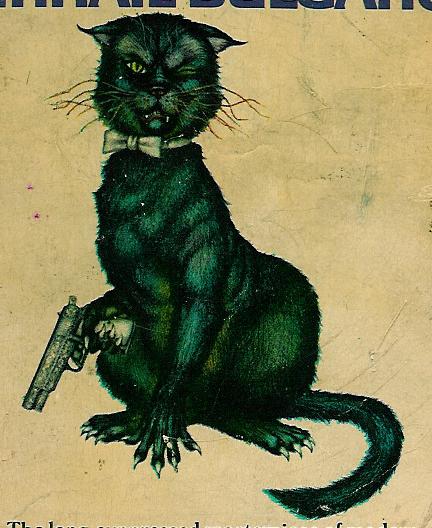
Behemoth (from the Jewish Encyclopedia)
Behemoth
Collin De Plancy- Images from Dictionnaire Infernal
Bulgakov (Library of Congress Bibliography)
Monday, December 13, 2004
Random Meanderings:
Thorstein Veblen (Theory of the Leisure Class)
Maxim Gorky
On Time:
Margaret Church (Time & Reality)
Time & Its Discontents (John Zerzan)
Thorstein Veblen (Theory of the Leisure Class)
Maxim Gorky
On Time:
Margaret Church (Time & Reality)
Time & Its Discontents (John Zerzan)
Auto-Da-Fe by Elias Canetti is a curious work. A novel that revolves around a cantankerous pedantic bibliophile will always catch my attention. Peter Kein, "the world's most famous sinologist" limits his reality to a world of Symbols, Signs, and Ideas- dry, academic, and rational.
I cannot say that the novel is gripping throughout- in fact, it was when I was not focusing on the text itself that the novel had its greatest sway over me. This statement is not vacuous double-speak. What I mean is- it was the aura of the novel, what it suggested or rather, its intima that affected me. I could not help but feel the great possibility for Tragedy (In Whitehead's sense of tragedy which "resides in the solemnity of the remorseless working of things") at each comma and every period. Ultimately, this is all borne out.
While Im aware of the socio-political interpretations of the work, I'm either too ignorant or too hard-headed (but why choose? ad*) to allow the novel to be so categorized. Instead, I like to focus it in the tradition of Huysmans and Musil- the clash of Individual and Society. But here, the impetus towards tragedy is epistemological and not sociological. (But how seperable is this?, ad)
* advocatus diaboli
Elias Canetti and Hermann Broch in conversation
I cannot say that the novel is gripping throughout- in fact, it was when I was not focusing on the text itself that the novel had its greatest sway over me. This statement is not vacuous double-speak. What I mean is- it was the aura of the novel, what it suggested or rather, its intima that affected me. I could not help but feel the great possibility for Tragedy (In Whitehead's sense of tragedy which "resides in the solemnity of the remorseless working of things") at each comma and every period. Ultimately, this is all borne out.
While Im aware of the socio-political interpretations of the work, I'm either too ignorant or too hard-headed (but why choose? ad*) to allow the novel to be so categorized. Instead, I like to focus it in the tradition of Huysmans and Musil- the clash of Individual and Society. But here, the impetus towards tragedy is epistemological and not sociological. (But how seperable is this?, ad)
* advocatus diaboli
Elias Canetti and Hermann Broch in conversation
Wednesday, December 08, 2004
Tuesday, December 07, 2004
1. Der Abentheurliche Simplicissimus Teutsch-Hans Jakob Christoffel von Grimmelshausen
2. The Anatomy of Melancholy- Robert Burton
2. The Anatomy of Melancholy- Robert Burton
I need to spend more time writing. The present conflict is whether electronic writing is the correct medium. On the one hand there is ease of use, ability to correct or erase what I now feel foolish of saying in the first place. Of course there is also the vainglory of even comtemplating that Someone Else is reading what I have to say.
I came across an interesting blog today which I must admit brought back the guilty feelings of abandoning this blog once I received a job offer last year. I must also admit that I feel some jealousy in finding that someone else finds Grimmelshausen's work as a source of inspiration (perhaps?) and entertainment (no doubt).
Gentle readers (ha!) I have found the password to this blog finally..and unless I determine to use good to honest pen and paper to chronicle my thoughts, I will update this more frequently.
For now, I leave this
I came across an interesting blog today which I must admit brought back the guilty feelings of abandoning this blog once I received a job offer last year. I must also admit that I feel some jealousy in finding that someone else finds Grimmelshausen's work as a source of inspiration (perhaps?) and entertainment (no doubt).
Gentle readers (ha!) I have found the password to this blog finally..and unless I determine to use good to honest pen and paper to chronicle my thoughts, I will update this more frequently.
For now, I leave this
Thursday, May 20, 2004
A recent point of interest has been the epistemological consequences of neo-darwinian theories of evolution. I have not thought it out sufficiently however it would seem if adaptation is supreme then one is almost forced into a position of skepticism. Then again, Im not sure that this is particular to ultra-darwinism.
Tuesday, January 20, 2004
La recherche du Lost Certainty
The middle of January, eighty cover letters, eighty cirriculum vitaes, eighty statements of purpose later. I sit here in a coffee shop having picked up Sophocles' Oedipus Rex in an attempt to forget that I have not been offered any job interviews yet. It is true that a couple have voiced interest- a telephone interview, being placed on a "long list". In the end, however, both decided to invite other candidates to campus, based on their current needs. "Based on their current needs" - the job search equivalent to "It isnt you, its me".
The middle of January, eighty cover letters, eighty cirriculum vitaes, eighty statements of purpose later. I sit here in a coffee shop having picked up Sophocles' Oedipus Rex in an attempt to forget that I have not been offered any job interviews yet. It is true that a couple have voiced interest- a telephone interview, being placed on a "long list". In the end, however, both decided to invite other candidates to campus, based on their current needs. "Based on their current needs" - the job search equivalent to "It isnt you, its me".
Saturday, January 10, 2004
I was reading an interesting article about Gore Vidal's works in the holiday issue of the New York Review of Books where in his 'Inventing A Nation', building from Benjamin Franklin's speech at the Constitutional Convention "I agree to this Constitution with all its faults.....and I believe farther that this is likely to be well administered for a Course of Years and can only end in Despotism...". Franklin's premonition was of a time where a democracy would "become too corrupt to govern themselves". Vidal argues that this Despotic Government has arrived.
However, Franklin surely was aware of the similar prophecy in Plato's Republic. And while Plato argues for the inevitable disintegration of Democracy into Despotism, it is not tied to "popular corruption" (Vidal's phrase) but instead to the 'insatiable desire' of liberty - unchecked liberty. An interesting quote from the Republic: "In a democratic country you will be told that liberty is its noblest possession..." and so "[a] democratic state may fall under the influence of unprincipled leaders, ready to minister to its thirst for liberty with too deep draughts of this heady wine".
The line of thought that Plato and Franklin/Vidal spurred me to follow was this. The seemingly disparate causes of the disintegration of democracy into despotism reflected in the quotes above are both in play today. Accordingly, "popular corruption" can be seen as a corruption of the intentions of the Founding Fathers outlined in the Federalist Papers, the Constitution etc. But his 'popular corruption' has come in the form of Ignorance. An Ignorance of the majority of Americans of the principles upon which this country was founded. In turn, it is this ignorance that has allowed the idea of unchecked liberty to be improperly placed as the cornerstone of an American identity. Plato again "In such a state the spirit of liberty is bound to go to all lengths". Ironic, but fitting, that these lengths include the USA Patriot Act and pre-emptive war.
However, Franklin surely was aware of the similar prophecy in Plato's Republic. And while Plato argues for the inevitable disintegration of Democracy into Despotism, it is not tied to "popular corruption" (Vidal's phrase) but instead to the 'insatiable desire' of liberty - unchecked liberty. An interesting quote from the Republic: "In a democratic country you will be told that liberty is its noblest possession..." and so "[a] democratic state may fall under the influence of unprincipled leaders, ready to minister to its thirst for liberty with too deep draughts of this heady wine".
The line of thought that Plato and Franklin/Vidal spurred me to follow was this. The seemingly disparate causes of the disintegration of democracy into despotism reflected in the quotes above are both in play today. Accordingly, "popular corruption" can be seen as a corruption of the intentions of the Founding Fathers outlined in the Federalist Papers, the Constitution etc. But his 'popular corruption' has come in the form of Ignorance. An Ignorance of the majority of Americans of the principles upon which this country was founded. In turn, it is this ignorance that has allowed the idea of unchecked liberty to be improperly placed as the cornerstone of an American identity. Plato again "In such a state the spirit of liberty is bound to go to all lengths". Ironic, but fitting, that these lengths include the USA Patriot Act and pre-emptive war.
Friday, January 09, 2004
Random cogitation inspired in part by Billy Collin's poem Marginalia :
and next to them, written in soft pencil-
by a beautiful girl, I could tell,
whom I would never meet-
"Pardon the egg salad stains, but I'm in love."
As well as by a library's take on Marginalia .
I must admit to often contemplating the past readers of books. As a graduate student, I would attempt to stave off cerebral marasmus by descending into the bowels of the library in search of compelling esoteria. (One of my most interesting discoveries was Monumenta Chartae Papyraceae Historiam Illustrantia- Collection of Works and Documents Illustrating the History of Paper -edited by E. J. Labarre.) On such journeys, old forgotten tomes not only revealed their authors, but in the form of marginalia, their readers - a certain lost 'social commentary' that I find particularly interesting (somwhat more interesting than say, another labyrinthine find- The Footnote: A Curious History by Anthony Grafton).
I tend to pursue these thoughts more, but for the time being the question I would like to pose is: have you ever come across any beautiful marginalia in books you have borrowed from friends or the library or adopted as lost souls? The marginalia may be beautiful due to their particular insight or contrast to the book itself, or, as in the selection from Billy Collin's poem, beautiful because it breathed the spririt of humanity.
Subscribe to:
Comments (Atom)